I remember attending a formal reception in Tōkyō, back in the early 1990s. Part of my job at the time was to liaise with various government bureaucrats connected with the Japan Exchange & Teaching Programme (which offered me first the opportunity to be an assistant English teacher at a high school in Saitama Prefecture, just to the north of Tōkyō, and then to be a programme coordinator at a council that ran the programme—it involved multiple Commonwealth countries so I got used to British spellings).
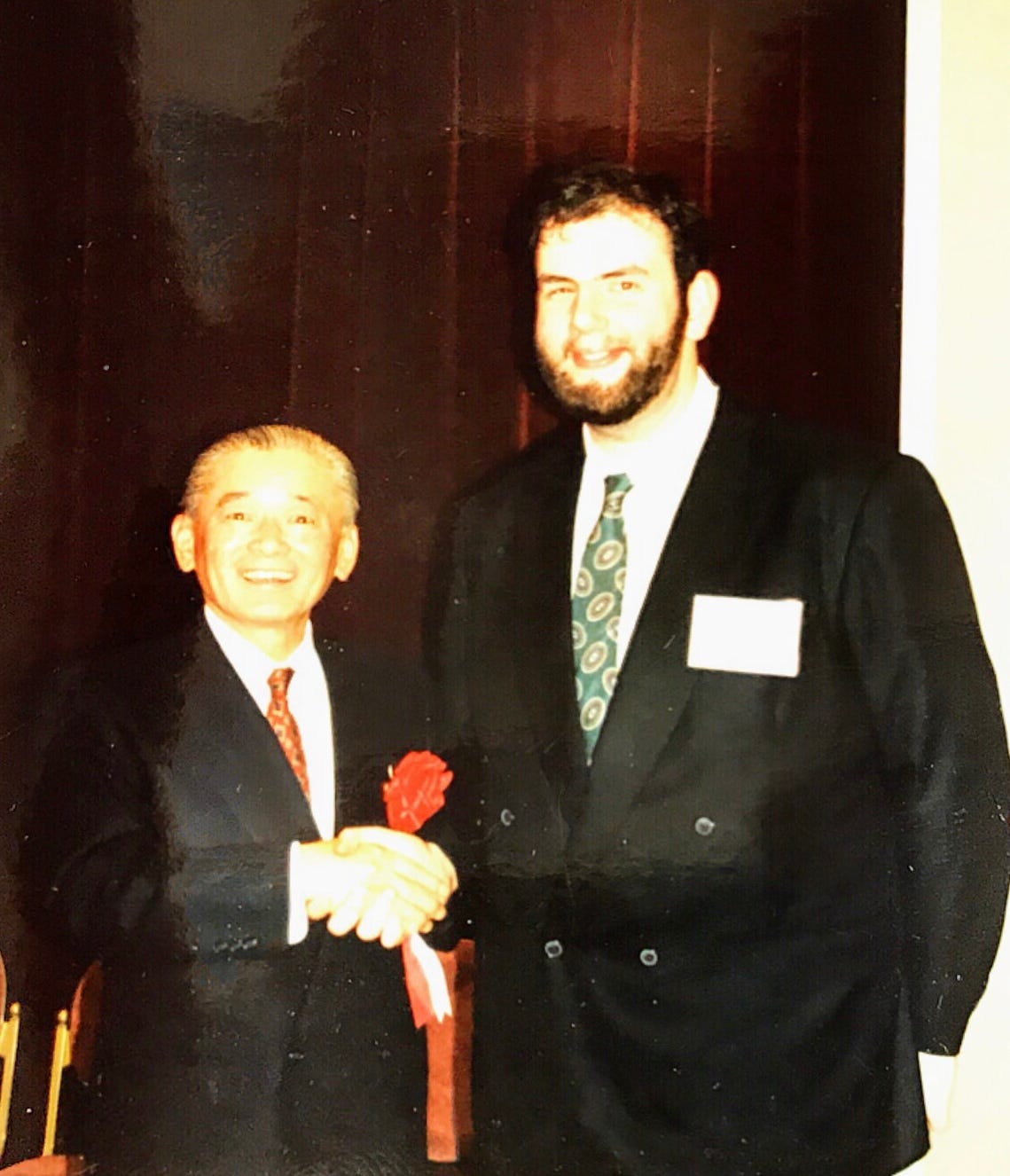
At this particular reception, a bureaucrat I had never met before sidled up to me and, between sips of Veuve Cliquot—Japan had just lowered tariffs on French wine imports and the Widow was suddenly cheap and abundant—insinuated that there were no gay people in Japan.
I didn’t respond. I was still in a professional closet then (although maybe my green necktie was a giveaway?) and couldn’t fathom what my inquisitor wanted from me.
What I would have liked to have said, however, was along the lines of “who the hell have I been (frequently and bodaciously) sleeping with, then?”
When I wrote about the old woman who made sure in the last issue, I promised that I would talk more about official, contracted relationships between teenagers and adult men, men who were either samurai or Buddhist monks. (The Japanese version of hoi polloi saved their money and visited pleasure quarters regardless of the gender they wanted to sleep with.)
But one thing I will not say is this: these formalized and extemporaneous sexual relationships would not be solid proof of identities we could today as gay. The penchant for men to love (physically and emotionally) other men throughout most of Japanese history was known as 男色 (danshoku, the allure of men). Because danshoku experiences occurred alongside 女色 (nyoshoku, the allure of women) in many men, those sexual and emotional entanglements with the same gender never coalesced into an identity the way that gay or queer has in the modern world.
(For every rule, there is an exception. Popular literature in (and after) the first century of the Tokugawa shogunate, i.e., the 1600s, made mention of men who self-identified as 女嫌い (onnagirai, women-haters). In most literary examples (which, it is safe to assume, reflected real life), these women-haters started with a contract, but never terminated that agreement.
But the expectation was that the contract would end.
Let’s consider samurai contracts first.
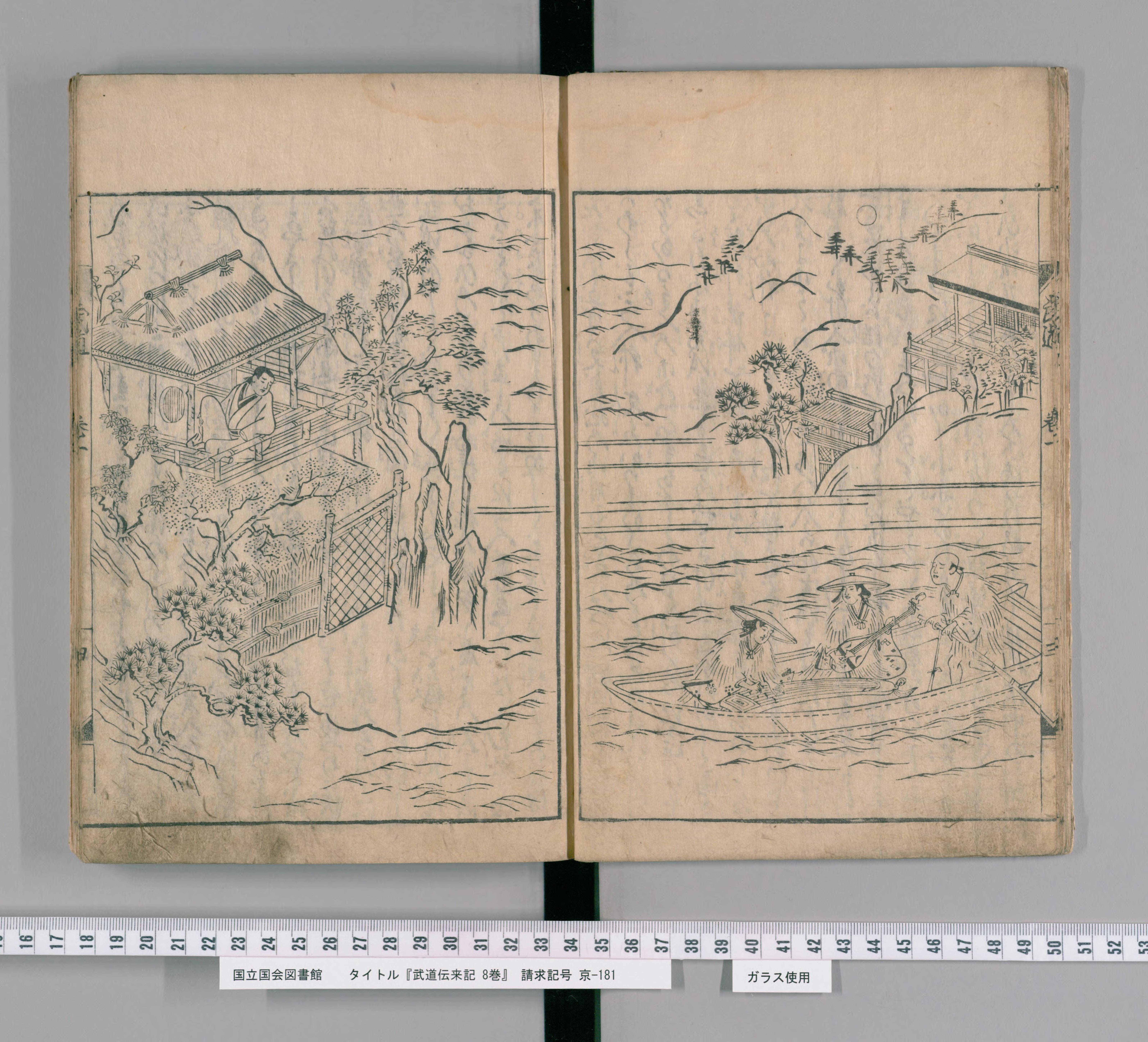
This image is from Japan’s National Diet Library, and is a two-page illustration from a book, 武道伝来記 (Budō Denraiki, The Written Legends of Samurai), by Saikaku Ihara (1642–1693). The illustrations are a single-color woodblock—the entire book was done using woodblock technology; you can see the bleed-through of text on the other sides of the pages—and were created by Yoshida Hanbei.
In the boat at right are two young squires, distraught that their samurai master has gone into seclusion. They have disguised themselves as fishermen and have (god only knows how) brought their instruments (a koto, the long zither-like one, and a biwa, the lute-like one), hoping that a performance will bring their master out of hiding.
At left, we see the master, curious at the music, arriving on his balcony.
The illustration shows the different types of abstract shorthand used by the artist. The details that are more important are rendered with a slightly greater degree of refinement, but the waves, the pine needles, the leaves, and the trees further in the background are almost stamped in, so repetitive are they.
Saikaku, the author, started life as a merchant’s child in Naniwa. He had a gift for poetry, but he found sudden fame (and wealth) when he started writing what today might be termed pulp fiction. His stories about the loves of the samurai and of nobles were immensely popular among the literate merchant and artisan classes, and they included the types of tropes that readers clamored for: star-crossed lovers, enemies-to-lovers, lovers-to-enemies, and, perhaps unique to pre-modern Japanese literature, ritual suicides.
What I love most about Saikaku is that after his first bestsellers focused on heteronormative relationships, he went all in on male-male relationships (and his readers bought out every edition of books like The Written Legends of Samurai and The Encyclopedia of Male-Male Love (男色の大鏡, Danshoku no Ōkagami). It was Saikaku who first used 女嫌い (woman-hater) to describe samurai who remained loyal to their pages, or to the love of other men, their entire lives.
(And yes, judging from Saikaku’s stories, those woman-haters were also misogynists—an easy thing to be in Japan, even now. One story tells of an old woman-hater couple who chased off young women from under the eaves of the couple’s home when a sudden storm sprang up, and the young women sought shelter. “No women shall linger here!”)
Let’s say you’re a thirteen-year-old boy in medieval or pre-modern Japan. Contracts for samurai relationships date back to the 14th century, CE (and we’ll talk about where they came from in the next issue), and you know that becoming a samurai will offer job and (usually) financial security. (During the long years of strife before Japan’s unification in the late sixteenth century, the burden of battle bankrupted some lords, rendering them unable to pay their samurai.)
You need a mentor, a samurai who will show you the ropes and, bonus, consider you his extra-special best friend. His butt buddy, as we say nowadays. Samurai were manly men, skilled in martial arts as well as poetry, calligraphy, and music, and making love to your young page is twice as manly as making love to your wife.
You are aware that sex is involved, but if you end up with the right samurai, he will be so affectionate and attentive that you will develop a sense of loyalty. And loyalty is another manly virtue, one that you should definitely cultivate.
And the terms of the contract, known as a 兄弟の契り (kyōdai no chigiri, a swearing, or attestation, among brothers), are clear: your samurai will not only teach you, but also take care of you, and attend to your needs, and you will both be faithful to each other. Until the contract ends.
When you reach twenty years of age, you will be considered an adult. You will cut your hair so that your appearance will resemble that of other adults. Your mentor might still be attracted to you, but the contract is clear. The relationship ends now. Your loyalty will remain intact—you will fight valiantly in battle together—but your adulthood frees you to marry a woman, and it frees both of you to form new contracts with new thirteen-year-olds. The circle of life!
But samurai life is not cloistered. And a contract might not guarantee total fidelity. Another samurai might find you attractive and want you for his own. You might find other men more attractive than your samurai. Dueling (with swords) happened. Ritual suicides happened. For the most part, however, you know your contract will bring you connections, will set you on the path to job stability, and might even help you get a wife.
Samurai were not a Band of Thebes, the ancient Greek army composed only of exclusive lovers. Sexuality in Japan (as written records indicate) was more fluid from the country’s earliest years onward. And yes, future issues will discuss that, too.
But there is something else that bears discussion. After the Meiji Restoration in 1868, when the emperor reasserted his status as Japan’s true ruler, Japan pressed hard on the Westernization button. Not only were railroads and government reforms brought to Japan, but the nascent (and specious) science of sexology also arrived. Legal reforms, which began with help from the British (ugh), introduced a new concept: sodomy. Thankfully, references to sodomy, written as 鶏姦 (keikan, literally and bafflingly written as chicken rape, and don’t get me started on how a character composed of three women, 姦, meant rape—you remember what I said about misogyny?) were removed from law codes when the French (yay!) got involved with Japanese legal scholars eight years after the British.
Sexology was part of a nineteenth-century scientific movement to classify and quantify everything in the natural world. I describe it as specious because sexology soon shifted from describing human sexualities as they are to positing that only one type of sexuality was normal, which ultimately birthed conversion therapy.
But in the late nineteenth century, sexology merged with the Meiji Emperor’s efforts to bring Japan to the same levels of so-called civilization and morality (so-called because there is nothing civilized or moral about colonialist capitalism) as Western nations. The perception of nanshoku changed (even if it wasn’t illegal), and a new sexology-inspired term arose in the 1920s: 同性愛 (dōseiai, same gender love, i.e., homosexuality).
So when that sneering bureaucrat at the reception slid into my personal space to let me know (highly erroneously) that there were no gay people in Japan, he was indicating one of two things (neither of which I wanted to hear him evince, because ew). A generous frame of mind might suggest he still believed in danshoku instead of dōseiai. The more likely conclusion is that the efforts begun during the Meiji Era to paint same-sex sexuality as unnatural and incompatible with the new Japanese morality had suffused his mindset. And cue the Britney Spears, because the latter conclusion is toxic!
Next week, I will go further back in Japan’s history and review some of the myths around same-sex attraction (Saikaku certainly had a fun version of Japan’s origin story), and the attestations entered into among monks and acolytes.
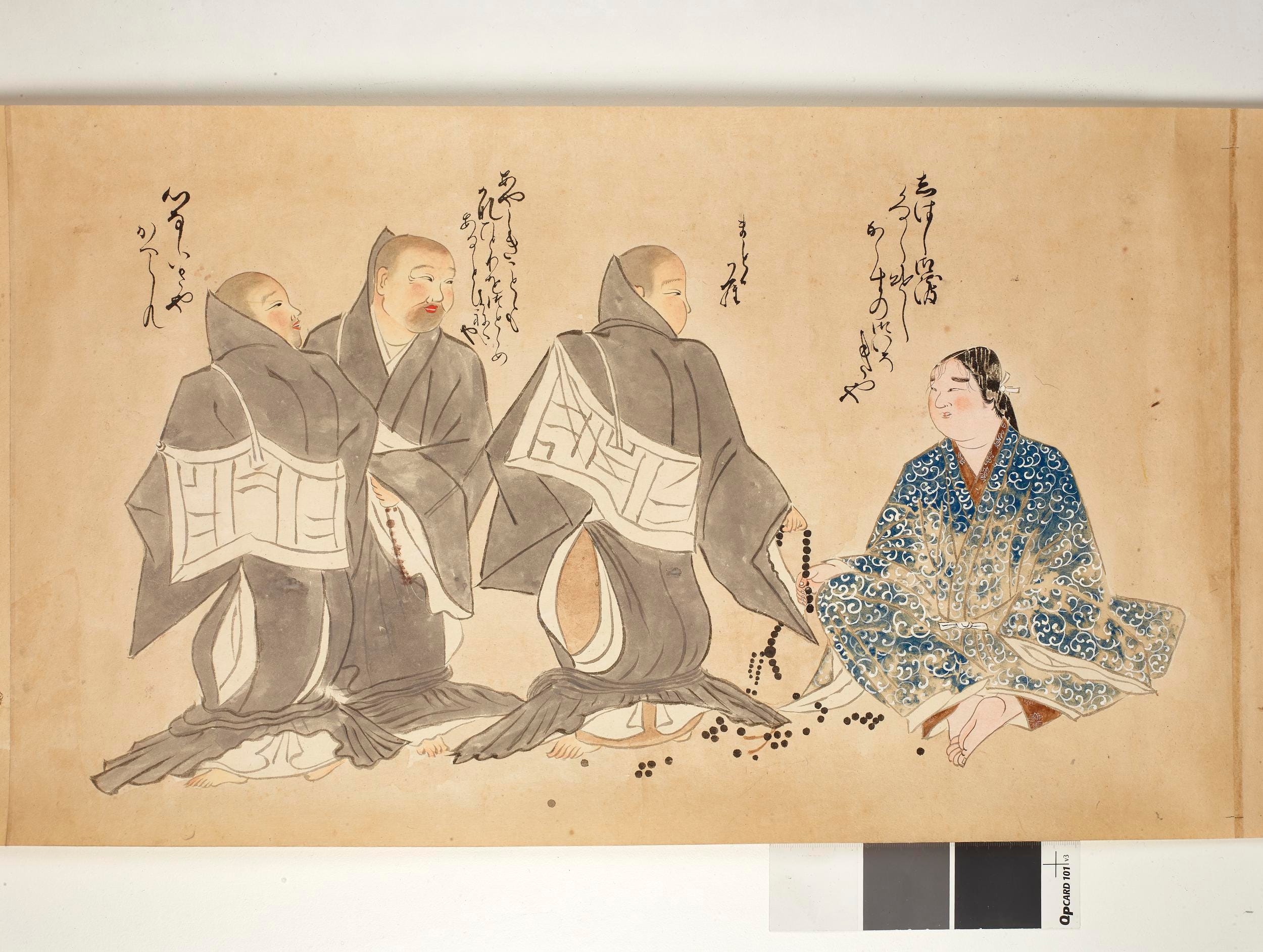
At right, a Buddhist acolyte, with his long hair and pale face indicative of his youth (and his beautiful civvies indicative of his nobility). In this nineteenth-century copy of a fourteenth-century scroll, known as the 稚児草紙 (chigo sōshi, the acolyte’s pillow book), the reader peers inside a monastery for a glimpse of the sex lives of monks, acolytes, and even the temple servants. Depicted here is a Hitchcockian image of temptation—the acolyte, hoping to catch the attention of a passing monk, grabbed his 数珠 (juzu, a Buddhist rosary with 108 beads) and, perhaps unintentionally, perhaps not, broke it, scattering beads across the floor.